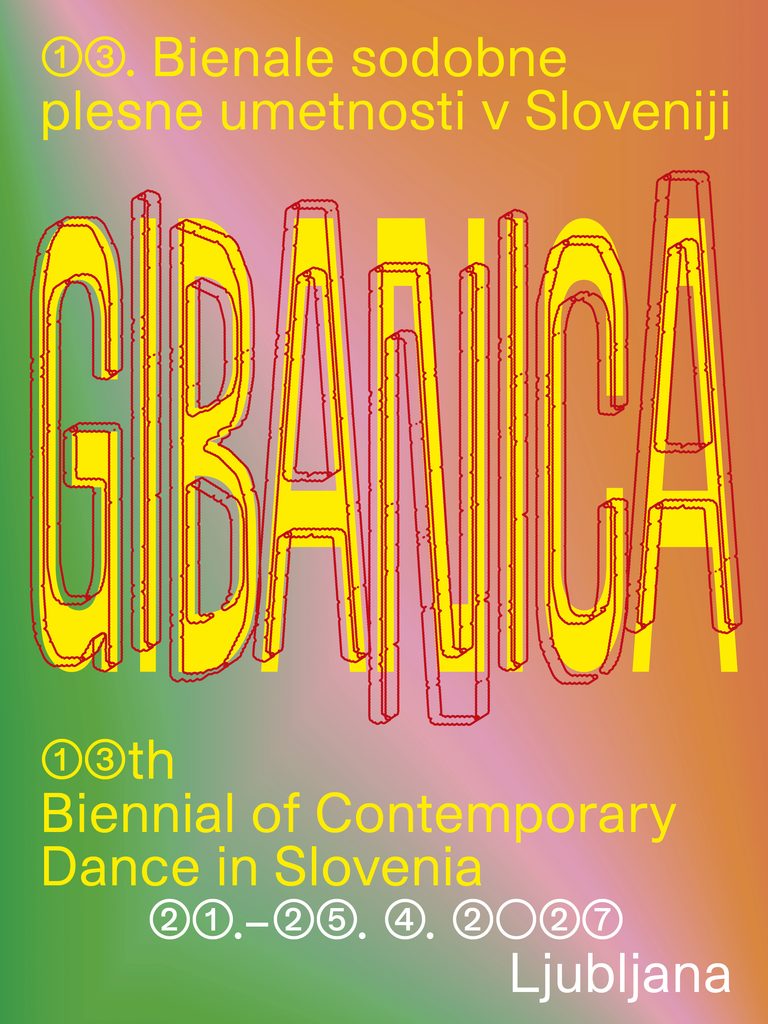
We are delighted to announce the performances in the main programme of the 13th Biennial of Contemporary Dance Art Gibanica, which will take place between April 21 and 25, 2027.
The selectors Alicja Berejowska (PL), Boštjan Antončič (SI/BE), and Metod Zupan (SI) have selected the following dance works for the main programme:
Andreja Rauch Podrzavnik: A FOLD
Kristýna Peldová, Enya Belak: Unfolded Moments
Matej Kejžar: House Bolero
Petja Golec Horvat: my own private*
Anamaria Klajnšček: VULNERI
Maja Delak (text by J. Tannahill): Declarations
Loup Abramovici: Autant pour moi! My mistake!
Kristina Aleksova: Three Quarters of a Human
In addition to the performances in the main programme, the selectors have for the first time also chosen 8 projects that will be presented in the form of “pitch” presentations.
Alongside the performances, the festival will also be shaped by talks, meetings, and gatherings that will open up space for the exchange of views, ideas, and experiences.
Selectors’ Statement
“Our task was to select eight performances from the 59 submitted works that premiered between 10 June 2024 and 30 June 2026, according to the criteria of originality of concept, quality of execution, coherence, and contribution to the diversity of contemporary dance aesthetics and practices. In addition to the criteria proposed by the Contemporary Dance Association Slovenia, our selection was informed by our diverse backgrounds in producing, curating, writing and creating, both within and beyond Slovenia.
Although Gibanica is not, in principle, a curated event, we were careful to ensure that the final selection reflected the criteria by which we evaluated the works, particularly their contribution to diversity – in the themes addressed, the approaches taken, and the gender, age, and origins of the artists.
Before us unfoldeda broad spectrum of vocabularies, interests, and performative forms – a body of work we admire and whose future concerns us. Only with this year’s selection have we apparently escaped the grip of infrastructural deprivation, which until recently manifested itself in the dominance of solos, shorter formats, and individualised motifs. Throughout the selection process, we received reports of the renewed erosion of an infrastructure built through calluses, sweat, and frayed nerves over decades of effort. We stand with the artists and believe that hard times call for courage, imagination, and furious dancing.
For Gibanica’s main programme we have selected the following performances (in no particular order):
Three Quarters of the Human by Kristina Aleksova explores three-quarter rhythm as both a social and choreographic form. The walz, or a reminiscence of its form, which is historically associated with a specific culture, social codes, and rituals of togetherness, becomes a framework for examining relationships, power, intimacy, identity, and belonging. The work does not present these questions as new political discoveries, but reminds us of the importance of returning to them again and again. Repetition, persistence, and determination highlight the strength of the En-Knap ensemble, whose dancers interpret the work with sensitivity and vulnerability, sustaining a delicate rigour and continuously seeking to bring the spectator into an intimate encounter with the piece.
In the aptly titled performance, Autant pour moi! My mistake!, Loup Ambamovici consciously embraces the pitfalls of both remembering and constructing history while questioning his own future within the uncertain and exhausting world of contemporary art. A broad choreographic concept gradually draws us away from theatrical spectacle, unfolding through quotation, translation, play, and enactment. At its core is a meticulously precise vivisection of the myth of the contemporary artist, deconstructed through an (inter)national, familial, material, gendered, and personal matrix, and guided by a mistake – an error in the relentless present. Tender and beautiful, as much as it is strange and difficult, the performance inhabits a complex ambiguity that we rarely encounter on stage.
Declarations (by J. Tannahill), choreographed and directed by Maja Delak, is a skillfully crafted work in which movement and spoken word are intricately interwoven. The constantly shifting distance and proximity between spoken text and movement create a dynamic tension that allows grief, loss, humour, and love to emerge and stay at the centre. Precisely structured from beginning to end, the work demonstrates remarkable choreographic clarity and compositional discipline, and is performed by an exceptional cast whose interpretations combine sensitivity, precision, and maturity.
A Fold by Andreja Rauch Podrzavnik exemplifies a performance – and a mode of thinking – rooted in so-called “expanded choreography”. In this third part of a triptych, the artist works with an object that is both large-scale and delicate, revealing not only the theatrical “fourth wall” but – quite literally – the behind-the-scenes mechanics of the work’s creation and artistic labour. Using a factory metaphor, she draws attention to all the “actors” – each on an equal footing – who form part of the chain of production and consumption of artistic products. She does this by engaging production staff and technicians as full-fledged performers and by choreographing the audience, who move alongside the performers, shifting their vantage points and the planes of action from one area of the “manufactory” to another.
In the hybrid dance-and-visual performance Unfolded Moments, Kristýna Peldová and Enya Belak weave a dialogue between video and dance, past and present, process and product. The camera captures the dancer’s body, face, and pupil; projected back onto her, these images recontextualise her, while she, in turn, recontextualises them. What unfolds before us is a study of the uncertainty of being, in which video offers a glimpse into the invisible idiosyncrasies and ephemerality of movement, while dance lays bare its inherent logic, such as the irreproducibility of every gesture. It is the living body, however, that transforms before our eyes, gently inviting us not to remain passive spectators amid the noise of the media.
House Bolero by Matej Kejžar offers a distinctive interpretation of Ravel’s Boléro. Drawing on its recognisable structure and hypnotic repetition, the performance opens a space for coexistence of dancers from different generations and diverse dance backgrounds. As in the music, questions of repetition, pulsation, seduction, and exhaustion emerge through a constantly pulsating space, celebrating individual expression while creating a vibrant, transgenerational body, – a body in which dance can happen.
In the dance performance my own private*, Petja Golec Horvat poses profound meta-artistic questions through the staging of personal fiction. She uses theatre as a space where dreams become reality, albeit within the safe confines of fiction. The dreamlike dramaturgy lulls us into a state in which cinematic references, fantastical images, and personal associations merge. As we drift between them, the performance oscillates between gentle familiarity and profound uncanniness. Visual projections and scenography intensify its multilayered quality, allowing immersion in a world that is at once distinctly personal and open to projections of our own private lives.
Anamaria Klajnšček’s Vulneri exemplifies the artistic language of the younger generation of Slovenian choreographers. Three performers move and interact within a single spotlight with a radius of one metre , accompanied by a pianist. It is a work pared down through artistic choices, choreographic tools, and stagecraft, in which themes of intimacy, vulnerability, freedom, social relations, and solidarity – all highly relevant and vitally important – engage with the crises and challenges facing contemporary society and the world.
For the first time, this edition of Gibanica is accompanied, alongside the competition programme, by a programme dedicated to works in progress: projects in development, with premieres planned for the coming year or two. The pitch programme offers artists the opportunity to present new projects or portfolios and to develop co-production or distribution partnerships, through which Gibanica seeks to nurture their future careers.
From the sixteen applications submitted, we selected the projects on the basis of the criteria outlined above. We chose the following artists for presentation: Leon Marič, Jan Rozman, Kolektiv YEBBA, Tara Ukmar and Bogumila Rozwadowska, Katja Legin, Ajda Tomazin, and Alja Branc Barbosa. Also presenting will be Klemen Kovačič, the recipient of the Grand Prix at the last edition.
We also propose to present a performance alongside the pitch and main programmes that, in its scale and artists featured, can be read as a love letter to Slovenia’s dance scene. Hurry Scurry Stay in Line is a horizontal, site-specific group piece for 16 performers, choreographed by a renowned artist acclaimed both locally and internationally. By arranging the performers in a single line – reminiscent of a runway, fashion show, audition, or panel review – Mateja Bučar uses choreographic tools to examine the interdependencies, relationships, mutual influences, and dialogues unfolding among performers who vary in age, style, dance aesthetics, and expressive language, and who metaphorically represent the Slovenian dance scene.“
Boštjan Antončič, Alicja Berejowska, Metod Zupan
Since 2003, Gibanica – Biennial of Contemporary Dance Art represents the Slovenian contemporary dance production, which is always selected for the festival by a three‑member selection team. Gibanica offers a curated selection of contemporary dance product by local producers and is considered the most important contemporary dance platform in Slovenia. DSPS was among the initiators and co‑founders of Gibanica, in which it has participated as a partner and co‑organiser since the first edition of the dance festival, and as a producer since 2011.