
SLOVENIAN MESSAGE FOR INTERNATIONAL DANCE DAY 2026
The Slovenian ITI Centre, the Contemporary Dance Association of Slovenia, the Slovenian Ballet Artists Association, and the Public Fund for Cultural Activities Republic of Slovenia have this year invited choreographer Mateja Bučar, recipient of the Prešeren Award for Life Achievements, to write the message for International Dance Day 2026.
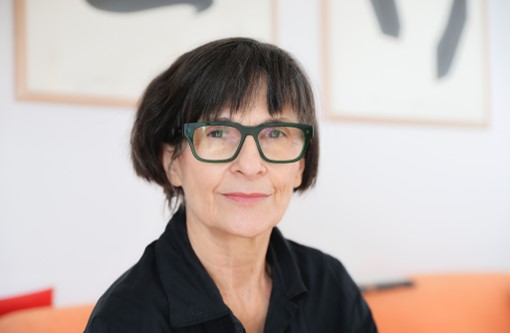
Dance–Governance–Grace
Dance is not a mere abstraction of life; it is life itself. It is the sophisticated mechanism of nature and civilization combined—a treasure chest of tools to enable, heal, and invent. On this World Dance Day, we recognize dance not just as a form of art and culture, but as a profound philosophy of the body and a vital strategy for survival.
At its core, dance is a fundamental inquiry into balance. It asks how two bodies, two states of being, or a multiplicity of cultures—perhaps all nations and even religions—can move together without colliding or destroying one another. It lingers in the fragile space between stability and fall, between the extremes of weight and articulation, in the unpredictability of turns.
To dance, namely, is to master the capacity to be oneself and “the other” simultaneously.
We recall the wit of Molière, who suggested that the tragic blunders of history arise merely from a lack of skill in dancing. If our leaders were obliged to study the discipline of the waltz, the tango, or any other culture-preserving dance, perhaps they would learn to lead with grace and dignity rather than pure force. And, as Confucius implied, the sword should not be granted to those who do not know how to dance.
Today, on World Dance Day, we make a bold demand: let leaders, strategists, economists, bankers, scientists, technologists, and many others study the knowledge of dance in all its forms and manifestations, and thus equipped, steer the world. We must once again learn the skills of “waltzes, tangos, or kolo”—their grace, dignity, attentiveness, and meaning—to restore the frayed bonds of humanity.
Every culture, state, or community in the world carries its own rhythms, songs, and dances of survival: the elegance of tango; the spiritual depth of Saman, Kathak, or Zikr; the precision of the pas de deux; the freedom of contemporary dance; the ecstatic force of shamanic dance; the pulse of breakdance—and much more. The challenge of our time is not just how one culture moves, but how to continually “waltz” with many cultures, states, and religions—and find rhythms and steps that respect the particular while harmonizing the whole. The answer—still largely unnoticed—resides within dancing bodies and minds across the world.
On World Dance Day, and beyond, we are called to reflect on the possibilities dance offers us—as art, as culture, and as a way of thinking and moving. Let us therefore treat every movement, direction, and decision in life as if it were on the verge of becoming a dance.
– Mateja Bučar
Dr. Mateja Bučar completed her studies in classical and contemporary ballet technique in 1979 at the Pôle National Supérieur de Danse Rosella Hightower in Cannes (France). In 1980, she joined the Slovenian National Theatre Opera and Ballet Ljubljana. In 1986, she also became a member of the Ljubljana Dance Theatre, founded two years earlier by Ksenija Hribar. In 1999, she founded DUM – Association of Artists, where she continues to collaborate artistically with Vadim Fiškin. Since 1992, her works have been presented both in Ljubljana and across Slovenia, as well as internationally, including in Vienna, Salzburg, Berlin, Moscow, Milan, Florence, Warsaw, Budapest, Zagreb, Rijeka, Stockholm, and Rotterdam. Her projects are conceived for diverse spatial contexts, ranging from theatre stages and gallery spaces to outdoor urban environments. In 2005, she received the Župančič Award of the City of Ljubljana. In 2014, she obtained the Ann Sayers Fund Award at Trinity Laban Conservatoire of Music and Dance in collaboration with City University of London, where she completed her PhD in 2015 with the dissertation Aesthetic Negativity and Choreographic Practice. In the same year, she received the Ksenija Hribar Lifetime Achievement Award from the Slovenian Contemporary Dance Association. In 2026, she was awarded the Prešeren Prize, Slovenia’s highest national award for the arts.
The Slovenian Centre ITI is part of an international network in the field of performing arts, the International Theatre Institute ITI, World Organization for Performing Arts, founded in Prague in 1948 by UNESCO. In Slovenia, it operates under the auspices of the ODER Cultural Institute in Ljubljana and connects Slovenian artists with the global theatre and dance landscape. The Slovenian ITI Centre develops and supports artistic, educational, and research projects, promotes the mobility of artists, and enables international exchange of knowledge and practices in a contemporary context. Through its activities, it contributes to the visibility of Slovenian performing arts internationally and strengthens dialogue between different cultures and artistic approaches.
The Contemporary Dance Association of Slovenia is the central professional association connecting creators, performers, and other professionals in the field of contemporary dance in Slovenia. It operates as a platform for advocacy, development, and promotion of dance, striving to improve working conditions, increase visibility, and strengthen systemic support for this artistic field. Through its programmes, awards, international collaborations, and networking activities, it reinforces the professional community and contributes to the development of a vital and socially relevant artistic expression.
The Association of Ballet Artists of Slovenia promotes Slovenian ballet art both nationally and internationally, ensures its preservation and further development, and works towards improving its status as well as the status of ballet artists. It brings together ballet institutions, supports, includes, and advocates for ballet artists, and provides support to ballet organizations and individuals working in the fields of ballet and dance. Its core programmes focus on presentation, promotion, advancement, advocacy, research, and the preservation of Slovenian ballet art.
The Republic of Slovenia Public Fund for Cultural Activities – Dance Department operates as a key national platform for the development, support, and promotion of dance creativity within the field of amateur culture. Through systematic education, the organisation of showcase events and competitions, and professional support for mentors and creators across Slovenia, it ensures accessibility of dance art in diverse environments. The Dance Department fosters the qualitative growth of dance practices, from initial steps to advanced forms of creation, and significantly contributes to the recognition and development of dance culture in Slovenia.
About the International Dance Day
In 1982, at the initiative of Slovenian dancer, choreographer, opera and ballet historian, professor at the Academy of Music, medical doctor, and writer Dr Henrik Neubauer (1929–2024), the Dance Committee of the International Theatre Institute (ITI) proclaimed International Dance Day. It is celebrated annually on 29 April, the birthday of Jean-Georges Noverre (1727–1810), the founder of modern ballet. Dr Henrik Neubauer, also the author of the first international dance message, was an active member of ITI Worldwide for several decades—initially as President of the Slovenian Centre after Slovenia’s independence, and later as its long-standing collaborator. In 2017, the organization named him an honorary member. International Dance Day was conceived in the spirit of celebrating dance, emphasizing the universality of this art form, transcending political, cultural, and ethnic boundaries, and connecting people through a shared language—dance. Since then, in addition to international and national messages, a wide range of activities, parades, festivals, and public-space events have taken place worldwide each year on this day.
The initiative to publicly mark International Dance Day in Slovenia has a history of more than fifteen years. In 2009, the Slovenian Ballet Artists Association, in collaboration with the newly established Slovenian ITI Centre, began publishing dance messages. In the same year, the initiative Go Out & Dance was launched by Goran Bogdanovski and Fičo Balet in collaboration with the regional network Nomad Dance Academy, taking place simultaneously in Ljubljana, Zagreb, Belgrade, Skopje, Sarajevo, and Sofia. In 2010, Fičo Balet continued the initiative in collaboration with Gledališče Ana Monro within the programme Prešerna Ana: Go Out and Dance in Ljubljana. The following year, the one-day festival expanded from Ljubljana to Maribor and Nova Gorica, with the newly established Nomad Dance Academy Slovenia as co-producer, alongside partners MN Dance Company and Živa dvorišča. In 2012, International Dance Day was marked in Ljubljana, Maribor, Nova Gorica, and Šempeter pri Gorici under the title Prešerna Ana, produced by Gledališče Ana Monro, joined by partner Terpsihora – Dance Centre Šempeter–Vrtojba. Following several years of interruption, in 2019 the Public Fund for Cultural Activities of the Republic of Slovenia reinstated the initiative to prepare the message for International Dance Day in the field of contemporary dance. Since 2020, the public marking of International Dance Day has been carried out in collaboration between the Slovenian Contemporary Dance Association and JSKD. In 2026, at the invitation of the Slovenian ITI Centre—which represents the core idea of International Dance Day at the global level—the Slovenian Contemporary Dance Association, JSKD, and the Slovenian Ballet Artists Association jointly contributed to the national dance message.
Festival in public space
DANCE FOR ALL
29. 4. 2026, 13h – 23h
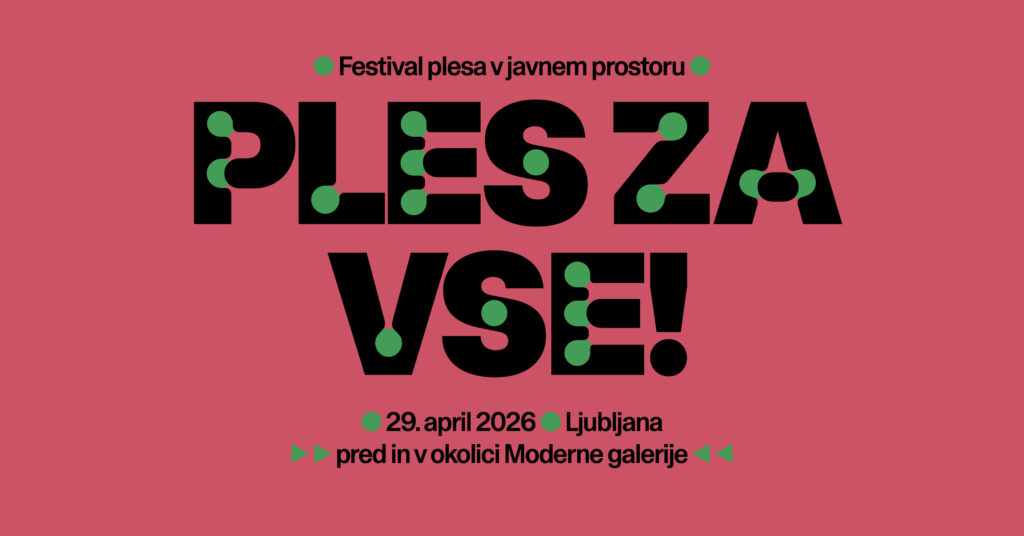
On the occasion of International Dance Day 2026, Ljubljana will once again transform into an open dance venue.
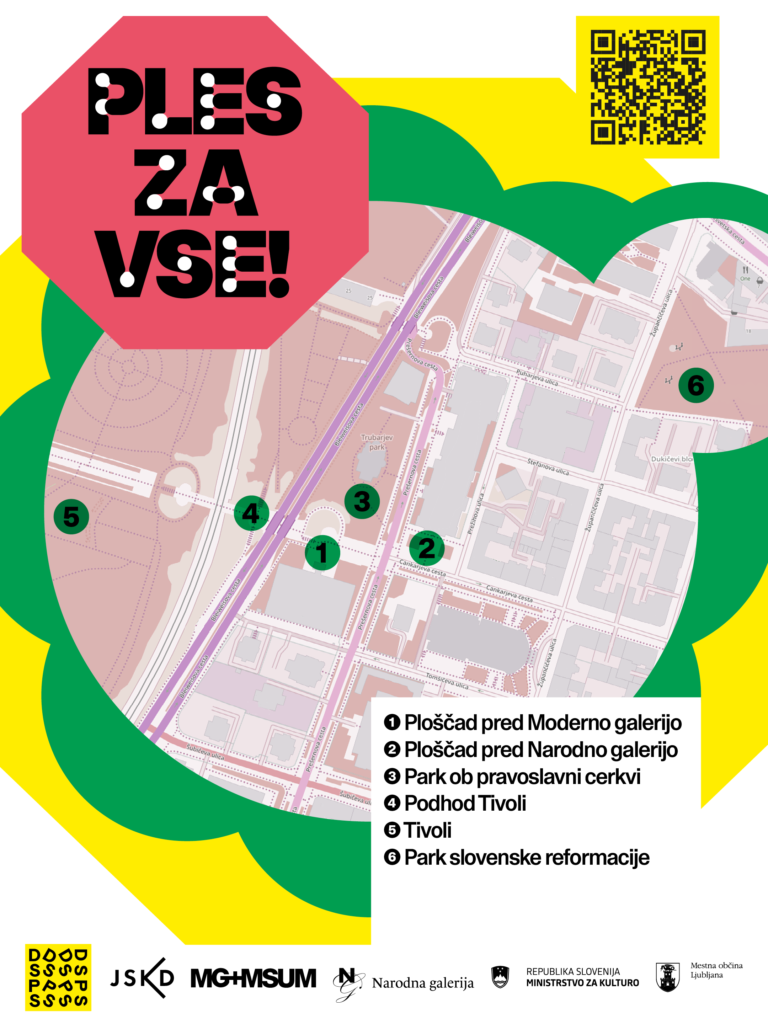
The programme will unfold in front of the Modern Gallery and the National Gallery, extending through the paths and corners of nearby parks – from the park by the Orthodox Church and the underpass leading to Park Tivoli, to the playground and the Jakopič Promenade.
Throughout the day, audiences will be able to move between locations, where short performances and interventions will take place. The programme will be complemented by open workshops for various target groups, a collective warm-up session, and an evening gathering with music.
For several years, the Slovenian Contemporary Dance Association, together with JSKD, has been marking International Dance Day. This year, however, the initiative has grown into a festival, opening space to a wider range of dance expressions and makers. The programme brings together professional artists, emerging dance groups, and amateur collectives, presenting a variety of dance styles – from contemporary dance and ballet to hip hop, flamenco, jazz, and folk dance.
Events will also take place in Celje, in front of the central library starting at 5 pm, and in Škofja Loka, with a meeting point at 6 pm at Cankar Square.
See you on 29 April at the dance promenade in Ljubljana, Škofja Loka, and Celje!
Concept and Executive Direction: Teja Reba
Artistic Council: Julija Matković, Nina Meško, Teja Reba
Producer and Administrator: Karolina Bugajak
Head of Promotion: Eva Simonič
Head of Communications: Sabrina Železnik
Spatial Design and Scenography: Maša Cvetko – Prostorož
Graphic Design: Mina Fina
Event Host: Dani Petković
Video Trailers: Gaja Madžarević
TikTok Content: Ava and Bela Reba Abramovici
Photographer: Sunčan Stone
Live Video Streaming: Radio Študent
Technical Director: Igor Remeta
Volunteer Coordinator: Ana Bajt
Volunteer Team: Alex Kodek, Katja Kolarič, Anja Šušmelj, Darja Vogelnik, Alona Yermachenkova, Karmen Zidanšek
Production: Slovenian Contemporary Dance Association
Partners: JSKD, MG+MSUM, National Gallery of Slovenia
In collaboration with: Alma Mater Europaea – Academy of Dance, Balfolk Ljubljana, Cirkulacija 2, Corazón Latino, CoraViento Association, Nomad Dance Academy Slovenia, Pekinpah Association, Conservatory of Music and Ballet Ljubljana – Higher Ballet School, KUD NUM, Bottoms Up Swing Dance School, Intakt Dance Studio, Warehouse 172, Studio for Free Dance, SVŠGUGL, Kuga Cultural and Sports Association, En-Knap Institute, Emanat Institute, Federacija Institute, Nest Institute, Sploh Institute, and many independent dance makers.
Sponsors: Isa Kombucha, Munchies, Dodo Pizza
Financial Support: Ministry of Culture of the Republic of Slovenia (within the multi-year project Gibanica), City of Ljubljana, Tourism Ljubljana.
International Dance Day 2024
20 meters in length, 9 meters in width, and 4 meters in height
April 29, 2024, 11:00 am–6:00 pm, Kongresni Square, Ljubljana
“The unfaithful imagination, what I like most about you is your ruthlessness.” André Breton, Manifesto of Surrealism (1924)
From the very beginning, Slovenian contemporary dance has been waiting for suitable infrastructure. For rehearsal spaces. For stable funding. For an institution. For dance studies. For better working conditions. For what every artistic genre, which is in the public interest, rightfully deserves.
The project’s title is derived from the dimensions of a modular studio designed for contemporary dance. We only saw it in the courtyard of the company that manufactured it. Allegedly, it now serves a different purpose. We lost it along with the public institution, the Center for Contemporary Dance Arts, which was abolished before it could come to life.
On International Dance Day, we will resurrect the lost studio from dreams and fill it with dreams. Because we, too, appreciate the ruthlessness of the unfaithful imagination. And because we love dance.
*The public institution was finally established on July 7, 2011, after a decade of preparations. In September, Igor Teršar assumed the role of acting director. Renovation for the arrangement of offices at the institution’s headquarters on Zaloška Street began. From the institution’s funds, a modular studio measuring 20 meters in length, 9 meters in width, and 4 meters in height was ordered, built, and paid for. Before the new year, Teršar resigned, and he was succeeded by acting director Matjaž Farič. On February 10, a new government under Janez Janša took office, and Dr. Žiga Turk reorganized the Ministry of Culture into the Ministry of Education, Science, Culture, and Sports. In March, Farič requested dismissal because, due to the new government’s decision, any conclusion of copyright contracts was prohibited, and the public institution could not employ, the lease contract for the office was not extended, and the acting director, after more than a month, did not receive a contract for his work. On August 23, 2012, the government adopted a resolution to abolish the public institution Center for Contemporary Dance Arts, estimating the savings for 2012 at 660,000 euros.
Dance Pavilion on Tour:
June 1st: Korpus Festival, Celje Main Square
June 7th: Kalejdoskop Festival, Kranj
August 29th: Platforma Festival, Maribor
CREDITS:
Conceptual design and project management: Sabrina Železnik, Teja Reba
Set design: Toni Soprano Meneglejte
Executive production: Tjaša Bertoncelj
Communication: Katja Lenarčič
Graphic design: Mina Fina
Proofreading: Tjaša Mislej
Translation: Katja Kosi
Photo documentation: Nada Žgank
Video documentation: Tina Šulc Resnik
Technical management: Igor Remeta
Technical support: Andraž Bobnar
Event moderator: Daniel Petković
Costume: Jan Brovč
Project partners: KUD Plesni forum Celje, KUD Kultivarnica Celje, KD Qulenium Kranj, Zavod Moja Kreacija, JSKD – Department for Dance Activities (Series of dance miniatures from the Opus 1 competition), GT22, Maska, The Hotel.
The project is supported by the Ministry of Culture, the Municipality of Ljubljana, and Turizem Ljubljana.